
What Is Triangulation in Research? Types, Methods & Examples
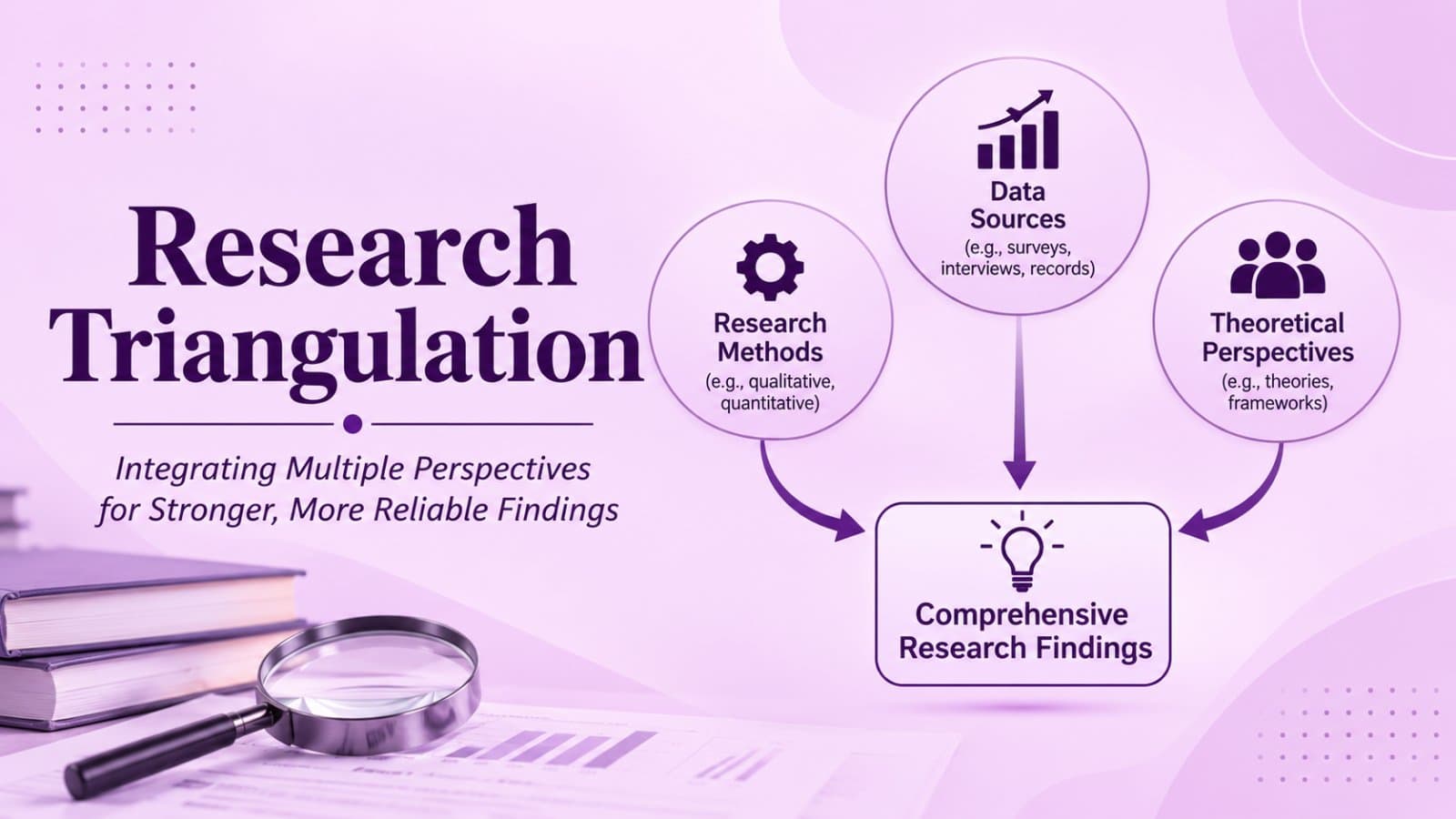
Triangulation connects different paths of inquiry, helping researchers move beyond isolated findings toward a more complete understanding of the research problem.
Results of research become more valid when analyzed from multiple angles. An individual interview, survey, observation, or dataset can be helpful in gaining some insight into a research problem; however, it will not necessarily present the whole picture of the research problem. Researchers usually use several sources of data for better comprehension of their results.
This technique is called triangulation in the research process. Triangulation is the technique that enables researchers to analyze the research problem using various approaches, sources of data, researchers, and perspectives. Instead of relying solely on one data source, triangulation allows researchers to compare the results and achieve a more profound comprehension of their research problem.
What Is Triangulation in Research?
Triangulation is a research technique that entails conducting research using various techniques in order to study the same research question or phenomenon. Evidence gathered from different sources or perspectives is compared and integrated in order to determine the relationship between different findings.
For instance, if a researcher wanted to study student engagement in class, the researcher would conduct classroom observations, interviews with students, and look at the academic performance of the students. Each of these sources will have something unique to contribute to the study of student engagement.
Triangulation does not require that all the sources used give the same findings. The differences between different findings can be equally informative.
What Is Triangulation Method in Research?
Definition of triangulation entails collecting, analyzing, and comparing the data derived from various sources or perspectives. The aim of this technique is not only to gather more information but to assess the way the different types of evidence play a role in solving the research problem.
The uses of triangulation include the following:
- Cross-comparison of the information collected through various sources.
- Comparison of similarities and differences in findings.
- Assessment of the complex research problem through various perspectives.
- Understanding why certain findings are found in one data set while absent in the other.
- Enhancing the validity and depth of research interpretation.
Triangulation is especially effective for conducting research in such fields as human behavior, education, healthcare, social sciences, etc.
Types of Triangulation in Research
Researchers commonly distinguish four major types of triangulation, based on the framework associated with Norman Denzin.
1. Data Triangulation
Data Triangulation refers to the process of gathering data from various sources, individuals, places, or periods in order to study the same research problem.
An illustration is a researcher studying employee satisfaction who gathers:
- Employee survey data.
- Employees’ interviews from various departments.
- Feedback data from the workplace.
- Employee satisfaction data from various months.
Comparing these sources can reveal whether satisfaction levels remain consistent across departments and time periods.
2. Methodological Triangulation
Triangulation of methods includes conducting research using several different methods for looking at the same phenomenon. Methods used could include surveying, interviewing, observing, experimenting, or analyzing documents.
For instance, an investigation on the effectiveness of online learning can be carried out by using student questionnaires, interviews of teachers, and class observations.
Surveying can establish trends in student satisfaction, interviews can explain individual experiences, and observing can show how students interact during online lessons.
This technique is especially important when each method provides additional insight into a research problem.
3. Investigator Triangulation
Triangulation of investigators includes the use of more than one investigator who analyzes the same data or conducts research on the same phenomena.
For example, there could be three different researchers analyzing the data collected during interviews conducted among university students. Comparison of results, exchange of ideas, and identification of common themes in the data can be done.
This method assists researchers in understanding their own assumptions and whether these assumptions affect the interpretation of data.
4. Theory Triangulation
Theory triangulation is the process by which research findings are analyzed from more than one theoretical perspective.
For instance, a researcher looking at motivation in the workplace can analyze worker behavior using:
- Maslow’s Hierarchy of Needs.
- Herzberg’s Two-Factor Theory.
- Self-Determination Theory.
In each case, there will be an entirely new way of explaining motivation. Comparison of all three perspectives can enable a researcher to gain insight into some aspects of worker behavior.
Importance of Triangulation in Research
Triangulation enhances research quality by helping researchers explore evidence using more than one method or perspective.
The significance of triangulation lies in the following:
- Increased credibility: Evidence from various sources provides better justification for interpretations of the research.
- Lower reliance on one source of information: Researchers are able to recognize the weaknesses of particular data collection techniques.
- Increased depth: Different perspectives can help find out contextual information, experiences, and patterns that would have been overlooked.
- Better interpretation: Comparisons allow researchers to tell whether pieces of evidence are in agreement, complement each other, or contradict each other.
- Greater transparency of conclusions: Researchers can explain what roles different pieces of evidence played in reaching certain conclusions.
It should be noted that triangulation does not necessarily make a research study valid and unbiased and does not prove the correctness of a conclusion reached.
How to Use Triangulation in Research: A Step-by-Step Process
Researchers can apply triangulation through a structured process that connects their research question with evidence collection, analysis, and interpretation.
Step 1: Define the Research Question
Start off by formulating a good research question that will show what is going to be studied.
For example:
What is the impact of online learning on student engagement?
Formulation of such a question aids in identifying the appropriate sources of evidence.
Step 2: Select the Appropriate Type of Triangulation
Select the technique depending on the research goal.
- If different subjects, situations, or timeframes matter, use data triangulation.
- If several methods of research can bring complementary information, use methodological triangulation.
- In case different researchers can independently interpret the findings, use investigator triangulation.
- When several theoretical approaches can help to explain the phenomenon, use theory triangulation.
Researchers can use more than one form of triangulation when needed.
Step 3: Identify Data Sources and Methods
Determine which sources or methods will provide meaningful evidence.
For a study on student engagement, these might include:
- Student questionnaires.
- Interviews with teachers and students.
- Classroom observations.
- Attendance and participation records.
Each source should have a clear purpose rather than being included simply to increase the number of methods.
Step 4: Collect and Analyze the Evidence
Data is collected using the proper research methodology. The data sets need to be analyzed in accordance with their nature and the methodologies chosen for analysis.
For example, questionnaires can be analyzed quantitatively, whereas interviews may be analyzed using the thematic approach.
Maintaining separation between the two analyses can assist researchers in realizing how each source can contribute to the process of comparison.
Step 5: Compare and Integrate the Findings
Examine the results for similarities, differences, and complementary insights.
Researchers can organize their findings using a comparison table:
| Research Evidence | Finding | Contribution |
|---|---|---|
| Student surveys | Students report high engagement | Identifies perceived engagement |
| Teacher interviews | Teachers observe participation | Provides classroom perspectives |
| Classroom observations | Participation varies across sessions | Reveals actual engagement patterns |
The researcher can then examine how these findings relate to the research question.
Step 6: Interpret and Report the Results
Show how the evidence supports, broadens, or conflicts with the research interpretations.
In the case of conflicting results, search for reasons why the results differ rather than choosing a result that seems most convenient.
The last step should include a description of the sources and evidence comparison process, and how the integrated results have contributed to the conclusions.
Examples of Triangulation in Research
The following examples demonstrate how triangulation can be applied across different academic disciplines.
Example 1: Triangulation in Education Research
A researcher wants to understand why students experience difficulties in mathematics.
The researcher collects:
- Student questionnaires about mathematics learning.
- Interviews with mathematics teachers.
- Classroom observations.
- Academic performance records.
Questionnaires could show that there are difficulties in certain subjects. Interviews with teachers may point out problems with explaining concepts, and classroom observation may show a lack of practice.
Together, these findings can provide a more comprehensive explanation of learning difficulties.
Example 2: Triangulation in Healthcare Research
An academician studies the quality of the healthcare services rendered to patients with chronic illnesses.
This research will entail conducting surveys, interviews, and document analysis.
Patient surveys can help determine the problems in communication, while interviews will show the difficulties of workloads, and document analysis will help to find out the tendencies in the process of treatment.
Such an approach will allow researchers to analyze the healthcare quality from different perspectives.
Example 3: Triangulation in Business Research
A company wishes to determine why its customers' satisfaction levels are falling.
Scientists analyze the data collected from customer surveys, sales, complaints from customer care, and even social media.
A response to a survey can reveal dissatisfaction with the quality of products, whereas a complaint to customer care could pinpoint technical issues with the product. Information from sales will demonstrate if that dissatisfaction is reflected in buying habits.
This information can help to describe the customers' experience better than just the survey responses.
Triangulation in Qualitative Research
Triangulation in qualitative research is especially helpful for situations when scientists are trying to understand some experiences, perceptions, social processes, or human behavior.
Qualitative research often makes use of interviewing, focus groups, observation, and documents. The use of different sources can enable researchers to look at various aspects of a phenomenon.
For instance, qualitative research on work-related stress can make use of employee interviews, observations at workplaces, and documents related to organizational policies.
Thus, interviews can give information about individual stress experiences, observations can provide data about stressful working conditions, and documents can give an account of organizational requirements.
It would be incorrect to expect all sources to corroborate the same themes. On the contrary, contradictions may prove to be interesting for further research.
Triangulation in Research Methodology: How to Report It
When triangulation is incorporated into a thesis, dissertation, or research paper, researchers should explain its role in the research design and how the evidence was integrated.
A methodology chapter may include:
- The research question and rationale for triangulation.
- The selected type or types of triangulation.
- Data sources, participants, and collection methods.
- Procedures used to analyze each dataset.
- The process used to compare and integrate findings.
- The approach used to interpret contradictory evidence.
- Limitations associated with the triangulation strategy.
Sample methodology statement:
Researchers should tailor this statement to fit their own research design rather than use methods that have not been employed.
Advantages and Limitations of Triangulation
| Advantages | Limitations |
|---|---|
| Provides multiple perspectives on a research problem | Requires additional time and resources |
| Helps identify inconsistencies in evidence | Integrating different datasets can be challenging |
| Supports more detailed research interpretations | Different methods may produce conflicting findings |
| Reduces dependence on a single source | Requires appropriate analytical expertise |
| Can strengthen the credibility of findings | Does not automatically eliminate bias |
Triangulation requires proper planning and method, as well as proper interpretation. Just having more data does not automatically mean better research.
Common Mistakes to Avoid
There are several things that researchers need to watch out for while triangulating data:
- Unnecessary data collection: Each of the methods and sources should add to the research question.
- Assuming agreement proves truth: Agreement on findings does not necessarily mean that they are true.
- Neglecting contradictions: Contradictory findings from different sources should always be addressed.
- Failing to connect evidence: Listing down separate datasets does not prove triangulation.
- Overstatement: Triangulation helps in interpreting the findings, but not in validating them.
Frequently Asked Questions
1. Is triangulation applicable only in qualitative research?
No. Triangulation can be employed for qualitative, quantitative, and mixed-methods research projects.
2. How does data triangulation differ from methodological triangulation?
In the case of data triangulation, different data sources, participants, settings, or time periods are used. In the case of methodological triangulation, several research methodologies are used to explore the phenomenon.
3. Are triangulation and mixed-methods research the same?
No. Triangulation is not a synonym for mixed-methods research; rather, mixed-methods research implies combining qualitative and quantitative methods of analysis, while triangulation implies using several sources or perspectives to compare/combine information.
4. Is it possible that different sources of information contradict one another during the process of triangulation?
Yes. Contradictions among the sources are possible. The researcher must try to find out why they exist and consider various contexts.
5. Why do researchers apply triangulation?
It is done to explore complex research problems from several perspectives.
Conclusion
Triangulation offers a framework for analyzing research problems from different sources, approaches, researchers, or theories. The strength of triangulation is not merely in the collection of different types of evidence, but in the appreciation of the relationships between that evidence.
Triangulation, when applied properly and meticulously, can enhance the quality, validity, and reliability of research findings. Researchers who analyze and make use of the relationships among different evidence can produce significant conclusions.
By comparing and integrating different forms of evidence, triangulation enables researchers to explore findings more critically and comprehensively.
References
Bailey, A., & Hutter, I. (2008). Qualitative to quantitative: Linked trajectory of method triangulation in a study on HIV/AIDS in Goa, India. AIDS Care, 20(9), 1119–1124. https://doi.org/10.1080/09540120701842811
Carter, N., Bryant-Lukosius, D., DiCenso, A., Blythe, J., & Neville, A. J. (2014). The use of triangulation in qualitative research. Oncology Nursing Forum, 41(5), 545–547. https://doi.org/10.1188/14.ONF.545-547
Fielding, N. G. (2012). Triangulation and mixed methods designs: Data integration with new research technologies. Journal of Mixed Methods Research, 6(2), 124–136. https://doi.org/10.1177/1558689812437101
Noble, H., & Heale, R. (2019). Triangulation in research, with examples. Evidence-Based Nursing, 22(3), 67–68. https://doi.org/10.1136/ebnurs-2019-103145
Vivek, R., Nanthagopan, Y., & Piriyatharshan, S. (2023). Beyond methodology: Theoretical foundations of triangulation in qualitative and multi-method research: A literature review. Social Science and Public Policy Journal, 2, 53–62. https://doi.org/10.61727/sssppj/2.2023.53