
Thesis Editing vs Journal Manuscript Editing: What Changes Are Required?
You've devoted months or maybe even years to your research. The data has been analyzed, the chapters have been written, and now it's time to improve your paper. However, one thing still causes uncertainty: is thesis editing similar to journal manuscript editing?
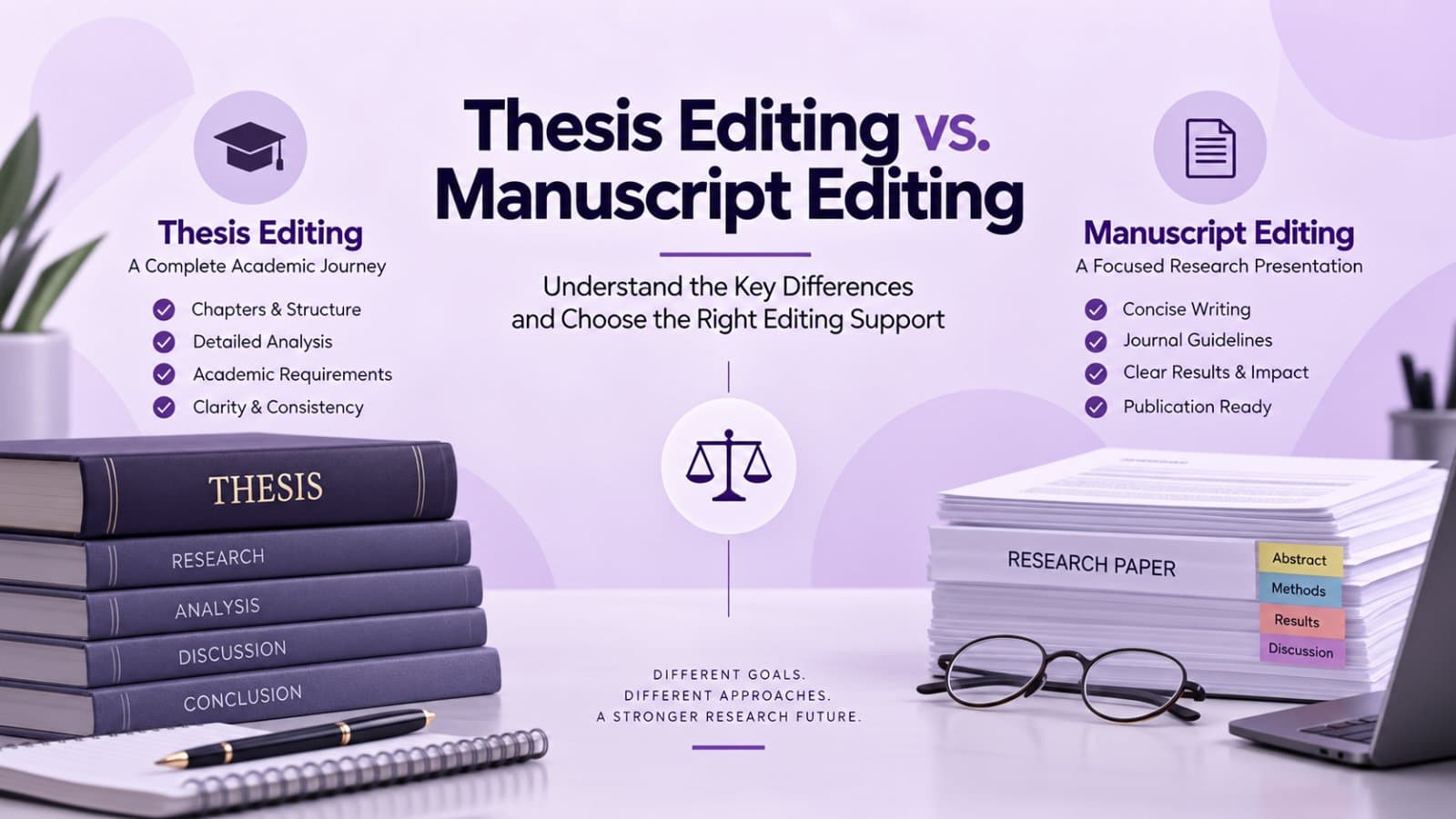
While both types of papers are derived from scientific research, they differ by purpose, target audience, structure, and requirements. Thesis explains your research in full detail, while a manuscript is a brief presentation of your research intended for publishing.
This implies that the process of editing should also be different.
What is the difference between thesis editing and manuscript editing? If you intend to publish your thesis study, what kind of editing will you really require? Let's find out.
What Is Thesis Editing?
The thesis is a complex academic paper that proves the author's capability to explore a certain topic, analyze relevant literature, use the proper methods, analyze results, and come up with significant conclusions.
Due to its complexity, the process of thesis editing services includes looking at the paper as a whole academic piece rather than individual sentences.
In its turn, the professional thesis edit can include such aspects as:
- Organization: Is there a definite purpose for each chapter and does it follow a correct sequence of the chapters?
- Research: Is there a development of ideas from the problem statement to the conclusion of the thesis?
- Language: Is the language employed by the writer professional and intelligible to the academic readership?
- Consistency: Are there any terminological, heading, abbreviation, citation, table, and formatting consistencies?
- Clarity: Can the reader comprehend the complicated ideas without difficulty caused by overly complicated sentences?
- Redundancy: Are there any repetitive ideas and explanations used throughout the paper?
- Grammar and Syntax: Are there any language inconsistencies distracting from the research?
This is where the editing of your thesis goes beyond simple language editing. This is intended for improving clarity, coherence, and quality of academic writing in your thesis while retaining the original ideas and findings that you have reached.
Think of it this way:
What Is Journal Manuscript Editing?
A journal manuscript, on the other hand, has a narrower goal, it should present the research results effectively to a particular group of journal readers and adhere to all publishing requirements.
A manuscript cannot contain all the information presented within a research project, as opposed to a thesis.
Journals usually impose strict publishing requirements regarding the number of words, format, length of an abstract, the number of references, figures, tables, and much more.
This makes the process of manuscript editing a more specific task.
It may include:
- Clarification: Explanation of the research in such a manner so that the readers are able to understand it without simplifying it too much.
- Language simplification: Elimination of any unnecessary details from the research.
- Coherence: The flow of logical information in the introduction, methodology, result, and discussion part of the essay.
- Point Highlighting: Point highlighting in order to make readers understand its significance.
- Journals requirements: Meeting the requirements of the journal where the research paper will be published.
- Tone: Keeping the tone scholarly.
- Consistency: Checking of terminology, abbreviations, references, tables and figures.
- Preparation for the peer review process: Detecting the weak spots where further explanation may be needed by the reviewers.
Simply put, editing an academic manuscript is not just about trimming a thesis.
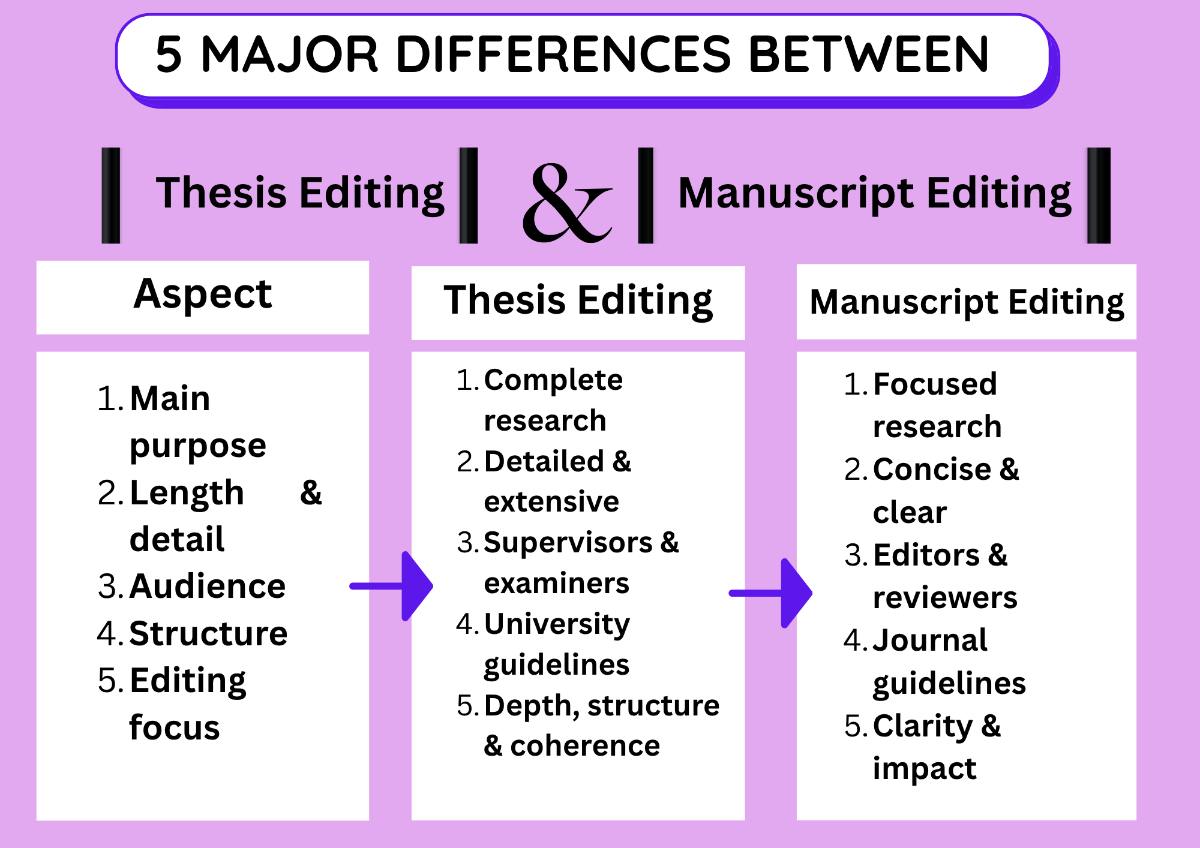
5 Major Differences Between Thesis and Manuscript Editing
Before looking at each difference individually, here's the bigger picture. Now, let's look at what these differences actually mean.
1. Purpose of the Document
Thesis editing
- A thesis is usually part of an academic degree requirement.
- It has to show how the research was done.
- The paper may describe in a lot of details the research problem, the theoretical framework, the methodology, the results, and the limitations of the research.
- Editing will then be concerned with making the whole process of research understandable.
Journal manuscript editing
- A manuscript is prepared primarily for publication.
- It needs to communicate the most relevant aspects of the research within a limited space.
- The editor must help ensure that the research question, findings, significance, and contribution are easy to identify.
- The focus is therefore more strongly connected to publication readiness and reader engagement.
2. Length and Level of Detail
Thesis editing
- These are generally much longer.
- Extensive literature reviews and methodological explanations are common.
- Background information can be explored in greater depth.
- Supporting information may be included in appendices.
- Editing often involves organising and clarifying large amounts of information.
Manuscript editing
- Journal articles usually have tighter word limits.
- Background information needs to be selective.
- Methodology may need to be condensed without removing essential details.
- Repetitive explanations can take valuable space away from the main contribution.
- Editing often involves reducing unnecessary detail while protecting important information.
3. Intended Audience
Thesis editing
- The primary readers may include supervisors, examiners, and members of an academic committee.
- They may already understand the research area or discipline.
- The thesis can therefore provide extensive explanations of the research process.
Manuscript editing
- The audience consists of journal readers, researchers, reviewers, and editors.
- Readers may have different levels of familiarity with the specific research problem.
- Key concepts and findings need to be communicated quickly and clearly.
- The writing must remain academically precise without becoming unnecessarily complicated.
4. Structure and Formatting Requirements
Thesis editing
- Follows the requirements of the university/department in most cases.
- The requirements might include chapters, headings, margins, referencing, tables, figures, appendices, and formatting.
- There are huge differences in requirements between different universities.
Manuscript editing
- Follows the selected journal's author guidelines.
- Requirements may include specific manuscript sections, word limits, abstract formats, reference styles, figure specifications, and reporting standards.
- A manuscript may therefore need to be edited with one particular journal in mind.
5. Overall Editing Focus
Thesis editing
- Look at the document as a complete academic project.
- Check whether chapters work together.
- Identifies gaps in transitions and logical connections.
- Improves academic language and consistency.
- Helps the thesis present the researcher's work clearly from beginning to end.
Manuscript editing
- Concentrates on the strongest and most relevant parts of the research.
- Removes unnecessary repetition and detail.
- Improves readability and precision.
- Strengthens the presentation of key findings and research contribution.
- Ensures the manuscript meets the expectations of its intended journal.
The simplest way to remember the difference:
Manuscript = communicate the important research clearly and efficiently.
Can You Turn a Thesis Directly Into a Journal Manuscript?
Yes, but you usually shouldn't treat it as a simple copy-and-paste exercise.
A completed thesis can provide an excellent foundation for a journal article, but a thesis and a manuscript serve different purposes.
A thesis might contain:
- An extensive literature review
- Detailed theoretical discussions
- A comprehensive methodology
- Multiple research questions
- Extensive results
- Detailed supporting information
- Appendices and supplementary material
A journal manuscript usually needs to be much more selective.
When converting a thesis into a manuscript, researchers may need to:
- Identify the strongest research question or finding.
- Reduce lengthy background information.
- Condense the literature review.
- Present only the methodology relevant to the article.
- Focus on the most important results.
- Restructure the discussion around the article's central contribution.
- Adapt the references to the target journal.
- Follow all the guidelines for submission in the journal.
- Review the paper for clarity, conciseness, and consistency.
It is for this reason that the process of manuscript corrections and editing may be required despite the initial thesis being professionally edited.
The key point is:
Which One Do You Need: Thesis Editing or Manuscript Editing?
Still wondering which one would suit your case? Consider the goal of the task first.
Go For Thesis Editing In Case You Are:
- Working on your master's or PhD thesis.
- Looking for better clarity across chapters.
- Struggling with consistency between different sections.
- Trying to improve academic language and structure.
- Finalizing the manuscript after feedback from the supervisor.
- Grammar, formatting, citations, or coherence issues worrying you.
Select Manuscript Editing If You Are:
- Preparing a research paper for journal submission.
- Converting part of your thesis into a journal article.
- Trying to meet a journal's word limit.
- Manuscript preparation following receipt of comments from reviewers.
- Striving for better clarity and conciseness.
- Preparing your paper for a specific target journal.
- Seeking professional manuscript editing services before submission.
What If You Need Both?
That is completely possible.
Thesis editing may be used by an author to edit his/her dissertation before it is submitted for academic publication and manuscript editing when he/she decides to publish some of the results in a journal article.
Thesis editing and manuscript editing are related, but they are not interchangeable activities.
The Bottom Line
Thesis editing and journal manuscript editing may look similar, but their goals are different. A thesis presents the complete depth of your research, while a journal manuscript focuses on its key findings and contribution.
This will influence the structure, length, language, audience, and approach to editing. Even a well-edited thesis can require restructuring before being sent for journal publication.
When you are in need of academic editing, thesis editing, or manuscript editing, take the approach that serves your purpose.
Frequently Asked Questions
1. How does thesis editing differ from manuscript editing?
Thesis editing deals with the whole process of conducting research. Manuscript editing is where the result of research is conveyed in a clear and concise way to ensure its publication in a journal.
2. Is it possible to make a thesis into a manuscript for a journal?
Yes. But it takes much effort to make a thesis into a manuscript. Manuscript is not just a shortened thesis.
3. What is manuscript editing?
It is an editing of your text in order to make it more coherent, more understandable, more logical, etc.
4. Is there a need for editing after I have made the conversion from my thesis to manuscript?
Yes, most times there is because even if you have had your thesis edited, there may be the need to do more editing to conform to the specifications of the target journal.
5. What do I choose between thesis editing and manuscript editing?
Thesis editing is the way to go when preparing your thesis for academic submission. Manuscript editing is for research work for publication in a journal.